
Performance Behaviours Framework
What is the core theory behind this Behavioural Framework?
The Framework operates on the premise that senior leadership performance is an emergent property of behavioural choices, cognitive regulation, and relational dynamics—not just technical competence or hard domain skills. By assessing behavioural patterns across core operational and interpersonal contexts, the Framework evaluates both a leader's immediate organisational output and the long-term sustainability of their impact.
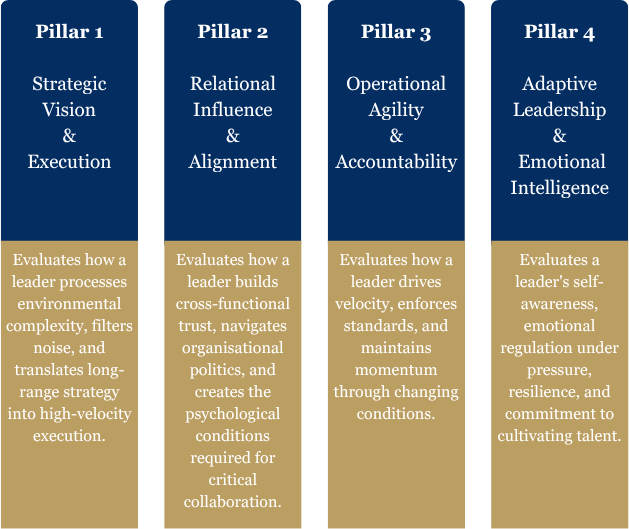
Pillar 1: Strategic Vision & Execution
Evaluates how a leader processes environmental complexity, filters noise, and translates long-range strategy into high-velocity execution.
Core Sub-Indicators:
Cognitive Filtering & Signal-to-Noise Ratio: Structuring complex strategic priorities into clear, actionable frameworks for the team without introducing cognitive overload.
Attentional Flexibility: Shifting seamlessly between high-level conceptual planning (far horizon) and tactical problem-solving (near horizon) without losing strategic orientation.
Strategic Prioritization Under Uncertainty: Allocating capital, talent, and operational bandwidth to high-leverage initiatives while maintaining calculated risk tolerance.
Psychological & Academic Foundations
Cognitive Load Theory (Sweller, 1988): Demonstrates that working memory has limited capacity when processing novel information. High-performing leaders optimize the "germane cognitive load" for their organization by converting complex market inputs into accessible mental models, preventing operational paralysis.
Executive Attention & Metacognition (Fernandez-Duque et al., 2000): Focuses on the self-regulatory mechanisms that allow leaders to monitor their own cognitive biases, manage attentional deployment, and pivot strategy when presented with disconfirming data.
The Leadership Pipeline (Charan et al., 2001): Frames the behavioural shift required as leaders transition from direct execution to strategic direction, emphasizing that executive failure is frequently a behavioural failure to shift cognitive focus and time allocation.
Pillar 2: Relational Influence & Alignment
Evaluates how a leader builds cross-functional trust, navigates organisational politics, and creates the psychological conditions required for critical collaboration.
Core Sub-Indicators
Psychological Safety Creation: Establishing an environment where team members can voice dissent, admit failures early, and propose radical ideas without fear of reprisal.
Cross-Functional Reciprocity: Breaking down organisational silos by building alignment across competing functional incentives and peer networks.
Constructive Friction & Conflict Navigation: Addressing relational friction directly and reframing interpersonal conflict into goal-oriented problem-solving.
Psychological & Academic Foundations
Psychological Safety (Edmondson, 1999): Established that team performance is strongly predicted by a shared belief that the team is safe for interpersonal risk-taking. The Performance Behaviours Audit audits whether executive behaviours actively encourage candour or inadvertently enforce silence.
Self-Determination Theory (Ryan & Deci, 2000): Shows that intrinsic motivation and sustained performance require satisfying three basic psychological needs: autonomy, competence, and relatedness. Executive behaviour is audited against how effectively leaders foster these conditions rather than relying on compliance-driven control.
The Five Dysfunctions of a Team (Lencioni, 2002): Provides the structural framework for auditing how the behavioural absence of trust creates fear of conflict, lack of commitment, avoidance of accountability, and inattention to collective results.
Pillar 3: Operational Agility & Accountability
Evaluates how a leader drives velocity, enforces standards, and maintains momentum through changing conditions.
Core Sub-Indicators
Decision Velocity under Ambiguity: Making high-stakes, irreversible decisions with incomplete data rather than delaying for perfection.
Accountability Architecture: Establishing clear, transparent ownership lines and following through on non-performance without damaging trust.
Friction Reduction & Process Elimination: Continuously identifying and removing bureaucratic bottlenecks that slow down organizational execution.
Psychological & Academic Foundations
Action Regulation Theory (Frese & Zapf, 1994): Focuses on the cognitive-behavioural sequence from goal formation to execution. Highly effective leaders demonstrate high action-orientation—translating intentions into immediate, structured feedback loops rather than getting trapped in contemplation loops.
Arousal & Performance Dynamics / Yerkes-Dodson Law (Yerkes & Dodson, 1908): Demonstrates that cognitive performance increases with physiological and neural arousal, but only up to an optimal inflection point. The PBA audits how leaders regulate performance pressure—keeping teams energized in the optimal performance zone without pushing them into acute distress or operational burnout.
Organizational Health Index & Agile Leadership (McKinsey & Co. / Rigby et al., 2016): Research demonstrating that long-term enterprise value creation is driven as significantly by execution agility and role clarity as it is by formal corporate strategy.
Pillar 4: Adaptive Leadership & Emotional Intelligence
Evaluates a leader's self-awareness, emotional regulation under pressure, resilience, and commitment to cultivating talent.
Core Sub-Indicators
Emotional Self-Regulation & Stress Absorption: Regulating personal emotional responses during high-stakes crises so as not to project panic or hostility down the organization.
Vulnerability & Receptivity to Feedback: Actively soliciting disconfirming feedback, acknowledging personal blind spots, and demonstrating a growth mindset.
Talent Cultivation & Succession Coaching: Investing deliberate effort into coaching direct reports and building long-term organizational capability.
Psychological & Academic Foundations
Process Model of Emotion Regulation (Gross, 1998): Differentiates between antecedent-focused strategies (such as cognitive reappraisal) and response-focused strategies (such as emotional suppression). The PBA audits whether leaders use cognitive reappraisal under stress or rely on suppression, which degrades decision-making and increases physiological strain.
Implicit Theories / Growth Mindset (Dweck, 2006): Demonstrates that individuals who view talent and intelligence as malleable (growth mindset) handle failure significantly better and cultivate stronger teams than those with a fixed mindset.
Adaptive Leadership Framework (Heifetz, 1994): Introduces the distinction between technical challenges (solvable by expertise) and adaptive challenges (requiring changes in deeply held beliefs and behaviours). Measures whether a leader can step back ("get on the balcony") to diagnose complex situations objectively.