
Performance Behaviours Audit
14 days • 5–8 stakeholder interviews • AI-assisted analysis • Expert interpretation • Actionable insight
The Performance Behaviours Audit (PBA) provides a structured assessment of the behavioural patterns that shape senior leadership performance. It looks beyond technical competence and headline outcomes to understand how leaders operate across operational, interpersonal and strategic contexts.
The Audit examines observable behavioural patterns, the conditions in which they occur, their impact on colleagues and organisational performance, and the opportunities or risks those patterns may create. The objective is to produce a practical, evidence-informed picture that can support leadership development, organisational effectiveness and targeted intervention.
1. Purpose
2. The Performance Behaviours Framework
The Framework the underpins the Audit is built around four interconnected pillars. Together they provide a view of the behavioural choices, cognitive regulation and relational dynamics that contribute to senior leadership performance.
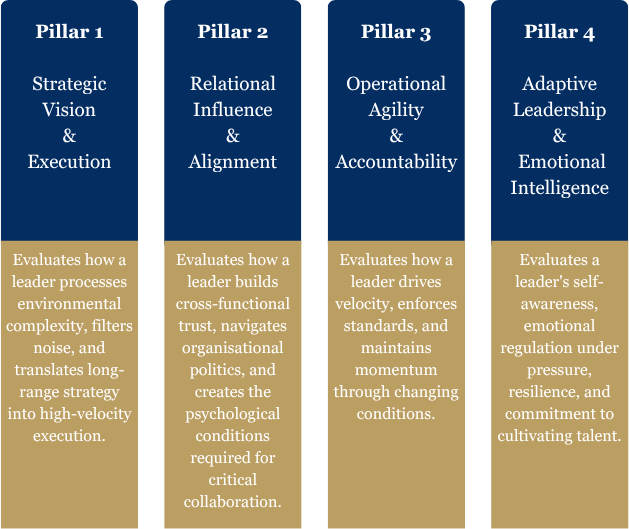
3. Audit Principle

The Audit does not treat an isolated comment or incident as definitive. Evidence is considered in context and tested for recurring patterns. The central question is not simply what happened, but what behavioural pattern is visible, under what conditions, and with what consequences.
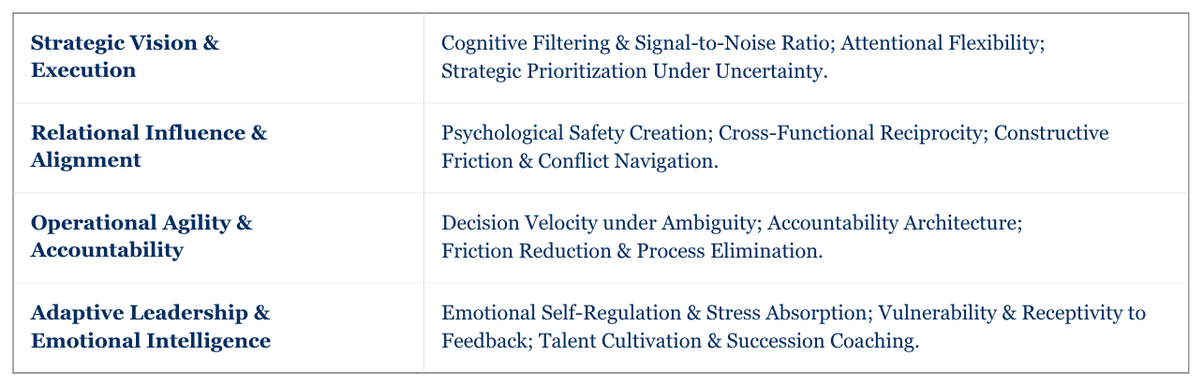
4. What is assessed
Each pillar is explored through three behavioural indicators:
5. Audit Scope and Delivery Model
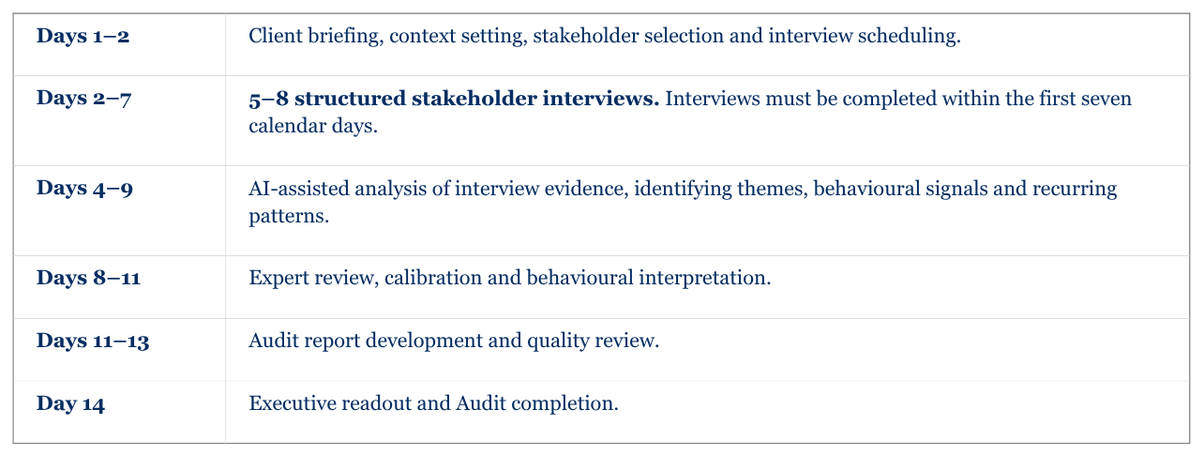
The Performance Behaviours Audit is designed as a focused, time-bound intervention. The standard Audit is completed within a maximum of 14 calendar days, using a cohort of 5–8 stakeholder interviewees.
The 14-day period recognises that stakeholder availability can be the practical constraint. To protect the overall delivery commitment, all stakeholder interviews must be completed within the first 7 calendar days of the Audit.
The client is responsible for ensuring that the agreed 5–8 stakeholders are available for interview within the first seven calendar days. Where interviews are delayed beyond this point, the 14-day completion commitment may need to be adjusted.
6. 14-Day Delivery Schedule
7. Stakeholder Interviews
The primary evidence source is a set of structured stakeholder interviews. The standard cohort comprises 5–8 people selected to provide relevant perspectives on the subject's leadership behaviour.
Interview questions are structured around the four pillars and their behavioural indicators, while allowing sufficient flexibility to explore examples, context and observed impact. The emphasis is on concrete experiences and observable behaviour rather than general impressions wherever possible.
The stakeholder group should, where appropriate, provide a range of perspectives across relevant organisational relationships. Selection is agreed during the client briefing.
8. Behavioural Interviewing
Interviews are designed to elicit behavioural evidence rather than simply opinions. Interviewees are encouraged to describe specific situations, what they observed, what happened next, and the impact on people, decisions, relationships or execution.
This approach helps distinguish between a perception of a leader and the behavioural evidence that may support that perception. It also provides context for understanding when a behaviour is effective, when it becomes less effective, and what conditions appear to trigger it.
AI is used as an analytical support layer within the audit process. Interview evidence can be analysed systematically to identify recurring themes, behavioural signals, similarities and differences across stakeholder accounts, and areas requiring closer expert attention.
AI analysis does not replace professional judgement. It supports the organisation and synthesis of qualitative evidence, while the final interpretation remains subject to expert review, calibration and contextual judgement. The purpose of AI assistance is therefore to improve consistency, pattern recognition and analytical efficiency within the fixed delivery window, rather than to automate judgement about a person's leadership behaviour.
9. AI-Assisted Analysis
10. From Evidence to Behavioural Patterns
Evidence is considered across multiple interviews and behavioural indicators. The Audit looks for patterns that are sufficiently repeated, specific or corroborated to warrant interpretation.
Particular attention is given to convergence across stakeholder accounts, meaningful differences in perspective, contextual triggers and the consequences associated with particular behaviours. The objective is to build a nuanced behavioural picture rather than a simplistic positive/negative assessment.
11. Strengths, Constraints and Behavioural Risk
The resulting profile considers areas where behaviour appears to support effective leadership, areas where behaviour may create constraints, and patterns that may represent latent organisational or leadership risk. Examples of latent risk identified by the Framework include decision bottlenecks, burnout-related patterns, psychologically unsafe conditions, reduced collaboration and friction that may not yet be visible in headline performance metrics.
12. Cross-Pillar Analysis
The four pillars are interconnected. A behavioural pattern identified in one area may influence another. For example, the way uncertainty is processed can affect decision velocity; emotional regulation can affect conflict navigation; and relational dynamics can influence accountability and execution.
The Audit therefore considers the overall behavioural system rather than treating each pillar as an isolated competency area.
13. Calibration and Professional Judgement
Before findings are finalised, evidence is reviewed for consistency, context and strength. Apparent contradictions are not automatically treated as errors; they may indicate that behaviour changes across situations, relationships or levels of pressure.
Professional judgement is used to distinguish robust behavioural patterns from isolated observations, assumptions or unsupported interpretations.
14. Audit Output
The Audit culminates in a concise, evidence-informed behavioural profile and executive readout. The output is designed to make the most important patterns visible and translate them into practical implications for leadership and organisational effectiveness.
Depending on the engagement, the output can include behavioural strengths, constraints, recurring patterns, contextual triggers, potential risks and development opportunities, together with practical areas for action.
15. From Diagnosis to Action
The Audit is intended to provide a bridge from observation to action. Findings can be used to inform individual coaching, team coaching, leadership development, stakeholder alignment, targeted organisational interventions or further diagnostic work.
The Audit does not prescribe a single intervention. The appropriate response depends on the behavioural patterns identified, the organisational context and the client's priorities.
16. Confidentiality and Use
Stakeholder interviews are conducted within the confidentiality arrangements agreed at the outset of the engagement. Reporting focuses on aggregated behavioural evidence and patterns rather than attributing individual comments unless explicit agreement has been reached.
The Audit is intended as a developmental and organisational effectiveness tool. It should be used responsibly and in accordance with the agreed engagement purpose, confidentiality arrangements and applicable data-protection requirements.
17. What the Performance Behaviours Audit Is — and Is Not
The Audit is:
A structured, evidence-informed assessment of behavioural patterns; a way of identifying strengths, constraints, risks and opportunities; and a practical input to leadership development and organisational effectiveness.
The Audit is not:
A measure of technical competence alone; a replacement for performance metrics; a psychological diagnosis; or a definitive judgement based on a single stakeholder's view.
The Performance Behaviours Audit is based on the premise that senior leadership performance is an emergent property of behavioural choices, cognitive regulation and relational dynamics—not simply technical competence or hard skills.
Business outcomes are important, but they are lagging indicators influenced by market conditions, historical momentum and other factors. Behavioural evidence provides an opportunity to examine how outcomes are being produced and to identify patterns that may support or undermine sustainable performance.
The Audit therefore combines structured human enquiry, AI-assisted analysis and expert interpretation to produce a focused picture of leadership behaviour within a defined organisational context.
18. Audit Philosophy
19. Framework Foundations
• Cognitive Load Theory — Sweller (1988)
• Executive Attention & Metacognition — Fernandez-Duque et al. (2000)
• Leadership Pipeline — Charan et al. (2001)
• Psychological Safety — Edmondson (1999)
• Self-Determination Theory — Ryan & Deci (2000)
• Five Dysfunctions of a Team — Lencioni (2002)
• Action Regulation Theory — Frese & Zapf (1994)
• Yerkes-Dodson Law — Yerkes & Dodson (1908)
• Organizational Health Index & Agile Leadership — McKinsey / Rigby et al. (2016)
• Emotion Regulation — Gross (1998)
• Mindset — Dweck (2006)
• Adaptive Leadership — Heifetz (1994)